

Updated: Aug 8
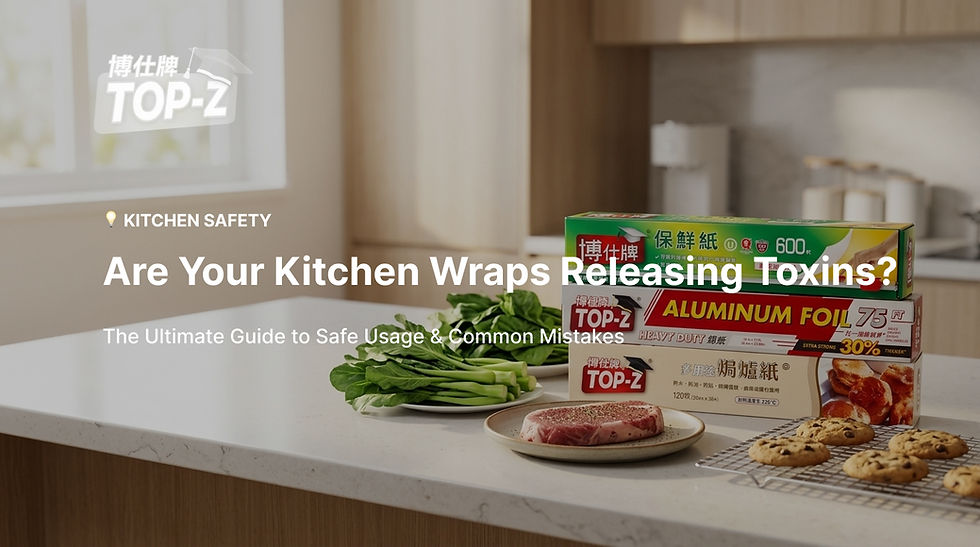
Many people in Hong Kong love cooking at home—whether it is showcasing your culinary skills with baked and roasted dishes over the weekend, packing homemade bento boxes for work, or wrapping up leftovers on weekdays. Aluminum foil, parchment paper, and plastic wrap are undeniably the "top three kitchen helpers" found in every household.
However, are you truly using these daily kitchen essentials correctly? Rumors often circulate online, such as "using the wrong side of aluminum foil can lead to metal leaching and toxicity" or "heating plastic wrap in a microwave releases plasticizers." Are these claims fact or fiction? This article debunked these myths once and for all, spelling out the correct usage and major warnings so that you and your family can eat with peace of mind. We will also share tips on how to choose premium quality kitchen products!
1. Aluminum Foil — The Ultimate Tool for Locking in Juices, But Absolutely Banned in This Appliance!

There is a never-ending online debate: "Should the shiny or the dull side of aluminum foil face the food?" Some people even worry that using the wrong side will cause metal to leach and release toxins.
💡 Shiny Side VS Dull Side: Which One to Use?
The Correct Answer: Both sides are perfectly safe to use, but the "shiny side facing inward" is recommended.
From a scientific standpoint, the difference between the shiny and dull sides is purely a physical outcome of the machine-rolling process during manufacturing. The difference in heat transfer efficiency between the two sides is negligible, and using either side will not generate toxins. However, because the shiny side has a slightly higher heat reflectivity and a smoother surface that is less prone to sticking, it is generally recommended to wrap food with the shiny side facing inward and the dull side facing out.
❌ Two Major Warnings for Using Aluminum Foil:
Never use it in a microwave: Aluminum foil is made of metal. The metal reflection inside a microwave will create sparks, which can cause fires or even explosions.
Avoid contact with highly acidic foods: Such as tomato sauce, lemon juice, and vinegar. Strong acids can cause the metallic aluminum to break free and leach into the food. While small amounts will not cause immediate poisoning, long-term accumulation is detrimental to health.
🌟 TOP-Z Expert Tip: Want to roast perfectly juicy chicken chops or sirloin steaks? We highly recommend TOP-Z Heavy Duty Aluminum Foil. Its thick, durable material resists tearing and distributes heat evenly to lock in natural juices perfectly. Furthermore, it has passed rigorous food safety certifications, allowing home chefs to cook with absolute confidence!
2. Parchment Paper / Baking Paper — The Non-Stick, Oil-Proof Master; Never Let It Touch This

Whether you are a baking enthusiast making cookies and cakes, or a modern family using an air fryer to render out excess fat, parchment paper is an indispensable tool for non-stick and oil-proof cooking. But did you know that parchment paper also has a lifespan and temperature limits?
💡 The Secret Behind Non-Stick Parchment Paper
Premium parchment paper features a safe, food-grade silicone coating on its surface, which gives it excellent heat resistance, water resistance, and non-stick properties.
❌ Two Major Warnings for Using Parchment Paper:
Never let it directly touch open flames or heating elements: Although parchment paper is highly heat-resistant (typically tolerating temperatures between 220°C and 250°C), it is still paper at its core. If the edges are too long and accidentally touch the heating elements at the top of an oven, or come into direct contact with an open flame, it will ignite immediately.
Never exceed the temperature limit: Always check the heat resistance temperature printed on the packaging before use. Exceeding its upper limit can cause the surface coating to degrade and emit thick smoke.
🌟 TOP-Z Expert Tip: Whether you are using an air fryer or a large oven, TOP-Z High-Density Parchment Paper features a double-sided food-grade silicone coating. It is not only highly heat-resistant and completely non-stick, but can also be easily torn to any required size. It is the perfect partner for home baking and healthy air-frying in Hong Kong households.
3. Plastic Wrap — A Must-Have for Food Preservation; 3 Crucial Keys for Microwave Heating

Wrapping up leftover food with a quick pull of plastic wrap and popping it into the fridge is a daily routine for every Hong Kong family. However, when it comes to reheating food in the microwave, hazards are often hidden in the details.
💡 PE vs. PVC Plastic Wrap: Which One to Choose?
The plastic wraps available on the market are mainly made of either PE (Polyethylene) or PVC (Polyvinyl Chloride). For health reasons, home chefs and homemakers are strongly advised to choose PE material. When heated or brought into contact with high-fat foods, PVC is highly prone to releasing harmful toxins like plasticizers, whereas PE material is relatively safe and stable.
❌ Three Major Warnings for Microwaving Plastic Wrap:
Never let it touch high-fat or high-sugar foods: When reheating foods like curry, braised pork, or sweet and sour pork ribs in a microwave, the oil temperature can easily soar past 130°C. If the plastic wrap directly touches the surface of the meat, the intense heat will melt the wrap, causing plastic components to blend into your food!
Do not seal completely when microwaving: During heating, water vapor will cause the air pressure inside the bowl to rise. If the plastic wrap is sealed too tightly, it can easily burst. Moreover, the trapped high-temperature steam can easily scald your skin when you peel the wrap off. When microwaving, always leave a small gap at the edge or poke a few small holes with a toothpick to let steam escape.
🌟 TOP-Z Expert Tip: TOP-Z Non-Toxic PE Plastic Wrap features exceptional cling and stretchability, and is 100% free of PVC and harmful plasticizers. It comes with a thoughtful, built-in safety slider cutter—just pull and slide for a clean cut without tangles or sticky messes. It perfectly fulfills Hong Kong households' dual demands for food safety and convenience.
📊 At a Glance: Correct Selection Guide for the Top 3 Kitchen Essentials
To give you a clear overview, TOP-Z has compiled this comparison chart. We highly recommend taking a screenshot to save it or share it with your family!
Kitchen Helper | Core Strength | Best Application Scenario | ⚠️ Critical Warning |
TOP-Z Aluminum Foil | Extremely fast heat transfer, locks in moisture, easy to shape | Roasting meat, wrapping seafood, grilling / barbecuing | ❌ Strictly prohibited in microwaves; avoid contact with highly acidic foods. |
TOP-Z Parchment Paper | Double-sided non-stick, oil-proof, high heat resistance | Baking cookies, lining air fryers | ❌ Strictly prohibited from touching open flames and oven heating elements. |
TOP-Z Plastic Wrap (PE) | Airtight odor protection, locks in moisture | Refrigerator storage and preservation, microwave reheating | ❌ Avoid direct contact with high-fat foods during heating. |
🛒 Protecting Your Family’s Health Starts with Choosing Premium Kitchen Essentials!
After reading this article, it is clear that using kitchen products correctly not only makes your dishes tastier, but also guarantees your family's health. The next time you restock your kitchen, make sure to look for premium brands that have passed rigorous food safety testing and are non-toxic and healthy.
TOP-Z is dedicated to designing a series of high-specification, safe, and practical kitchen products (including plastic wrap, aluminum foil, and parchment paper) for Hong Kong families. Just like you, we care most about the food safety of your loved ones.
Want to experience an easier, safer cooking life?
Comments